Drone Threats in Correctional Facilities
Drone Delivered Contraband Response Training
Why Grounded Drone Response Is Becoming a Critical Corrections Security Requirement
Correctional facilities have become one of the most active domestic environments for nefarious unmanned aircraft system (UAS) activity. What began primarily as isolated contraband drops has evolved into a broader security challenge involving organized smuggling networks, hazardous contraband, chemically treated materials, and increasingly sophisticated drone delivery tactics.
For many correctional agencies, Counter-UAS planning still focuses primarily on airspace detection and interdiction. Detection matters, but recent incidents continue to demonstrate that the most consequential phase of a drone incident often begins after the aircraft or payload reaches the ground. A drone that crashes inside a secure perimeter, abandons a payload near housing units, or delivers a suspicious package into a recreation yard is no longer only an airspace security problem. It becomes a safety, response, investigative, and potentially hazardous incident requiring deliberate ground response procedures.
A March 2026 incident at Marcy Correctional Facility in New York illustrates the growing challenge facing correctional agencies. Staff detected a drone flying above the facility grounds before it released a package inside the secure perimeter. Personnel recovered the package and observed wires protruding from it, prompting notification of the New York State Police Bomb Squad. Once rendered safe, the package was found to contain double-edged knives, narcotics, chemically treated paper, a cell phone, and additional contraband.
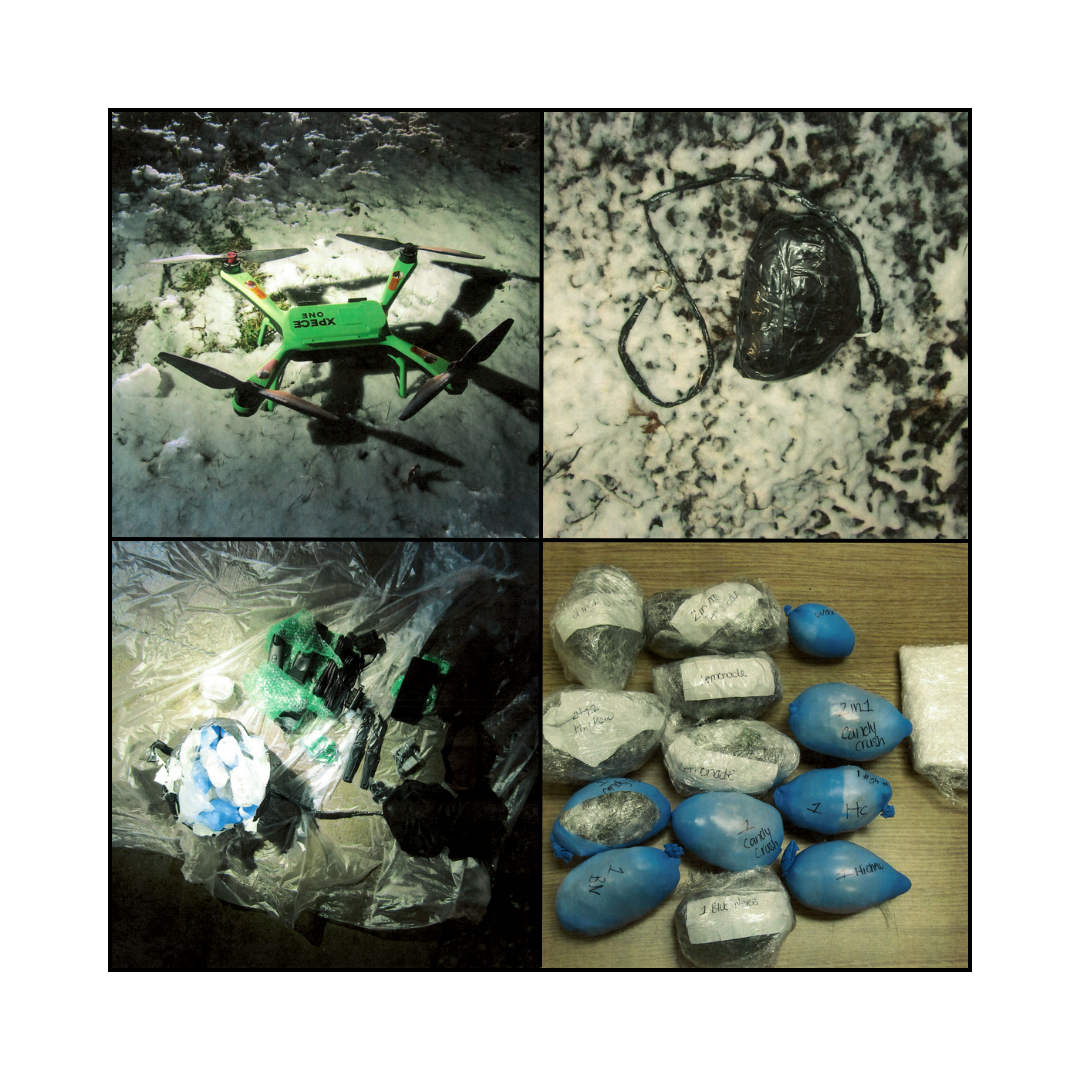
Top Left: Drone Recovered Outside Facility; Top Right: Dropped Payload Initial Discovery
Bottom Left: Payload After Bomb Squad Response; Bottom Right: Payload Contents
The outcome was positive because personnel recognized indicators requiring escalation and involved specialized responders before further handling occurred. However, the incident also highlighted a larger issue: many correctional personnel may be the first to encounter a grounded drone or suspicious payload without formal training on hazard recognition, scene management, evidence preservation, or escalation procedures.
The Threat Is Expanding Beyond Contraband
Contraband delivery remains the most common use of drones in correctional environments, but the threat profile continues to evolve. Modern drone incidents may involve narcotics, chemically treated paper, cell phones, weapons, surveillance equipment, improvised payloads, dangerous substances, or toxic materials. The Marcy incident itself involved weapons, narcotics, chemically treated paper, and a cell phone, demonstrating how a single drone delivery can create overlapping security, safety, investigative, and exposure concerns.
This matters because a grounded drone or recovered package should not be treated as a routine contraband recovery. A drone or payload may include unfamiliar electronics, damaged batteries, attached or detached components, leaking substances, suspicious packaging, or other indicators that require caution and escalation. Even when the aircraft appears unmodified or the payload appears unthreatening, the contents and configuration may contain hazards that are not immediately obvious.
Detection Alone Does Not Solve the Problem
Many agencies have invested in drone detection systems, airspace awareness, and mitigation capabilities. Those capabilities are important, but they address only the opening phase of a drone incident.
Once the drone or payload is on the ground, the response priorities change. Staff must know how to protect personnel, establish distance, avoid unnecessary handling, preserve the scene, notify appropriate supervisors and specialized responders, and maintain observation. Those priorities are reflected in grounded drone response guidance that personnel receive in Drone Incident Response Training (DIRT). DIRT courses emphasize personnel safety, standoff, evidence preservation, notification, and persistent surveillance.
For correctional agencies, the gap is often not whether staff can see the drone. The gap is whether they know what to do next.
Grounded Drone Response Requires Trained Personnel
A safe response to a grounded drone incident does not require every correctional officer to become a Bomb Technician, EOD tech, or HazMat specialist. It does require frontline personnel to understand the basic decision-making framework for recognizing a potential hazard and preventing the incident from becoming worse.
At the awareness level, that means personnel should be trained to slow the response down, create distance, avoid unnecessary handling, observe for suspicious indicators, control access to the area, and recognize when specialized responders are needed. DIRT courses also emphasizes that personnel should not focus solely on the aircraft itself because payloads or dangerous components may separate, become concealed, land away from the drone, or remain suspended or entangled.
For correctional facilities, this is especially important because the environment is constrained. A drone incident may occur near housing units, recreation areas, rooftops, perimeter fencing, vehicle areas, drainage features, or public-access boundaries. Staff must balance security, inmate movement, evidence preservation, and personnel safety while avoiding unnecessary disturbance of the drone or payload.
What Correctional Agencies Should Build Into Their Response Programs
Correctional agencies need internal procedures and training that address the ground phase of a drone incident. At a minimum, those programs should define:
who owns the initial response when a drone or payload is discovered
how staff should isolate and control the scene
what indicators require immediate escalation
how to communicate drone, payload, location, and disposition information
when Bomb Squad, EOD, HazMat, Counter-UAS, intelligence, or investigative personnel should be requested
how to preserve evidence and maintain continuity of operations
how responsibility is transferred when specialized responders arrive
This level of planning gives staff enough structure to act safely without improvising, while still reserving specialized procedures for trained responders and formal training environments.
The Ground Phase Is Where Risk Becomes Real
A drone flying over a correctional facility is an airspace security concern. A drone or payload on the ground is different. Once recovered, crashed, abandoned, or delivered, it becomes a physical object inside or near the facility that may contain contraband, evidence, dangerous substances, or components that pose an immediate safety concern.
That is why grounded drone response should be treated as a distinct discipline within correctional security. It requires more than detection technology. It requires trained personnel, clear escalation pathways, practical response plans, and scenario-based decision-making specific to the correctional environment.
Incidents like Marcy show that the threat is not theoretical. Drones are being used to deliver weapons, drugs, phones, and chemically treated materials into correctional facilities, creating direct risks for staff, incarcerated populations, civilian employees, and responding agencies.
The central lesson is straightforward: detection may start the incident, but ground response often determines the outcome.